


OMIM ID:
Cornea, Ring Dermoid
Alternate Names
Defective Genes
Clinical Characteristics
Ocular Features
Dermoids in this condition are found at the limbus extending onto the cornea anteriorly and into the conjunctiva posteriorly. They may be unilateral or bilateral and some contain functional hair follicles. They are present at birth and appear as raised yellow-white tissue which can be segmental or extend for the full limbal circumference. Some present as a dark ring around the cornea. The apophyses can be elevated 2-3mm and extend for 3-5mm laterally. Corneal changes, primary or secondary, lead to progressive vision loss in older individuals. Corneal distortion can result in significant astigmatism. Some patients have glaucoma and congenital cataracts.
Histological studies have not been reported.
Systemic Features
No systemic disease is part of this condition.
Genetics
Inheritance
Two families, one Peruvian and one Chinese, have been reported with autosomal dominant patterns of transmission. A G185A substitution in the PITX2 gene (4q25) cosegregated with the ocular disease in the Chinese family.
PITX2 encodes a transcription factor important to the development of multiple organs including the eye. Mutations in this gene have also been found in patients with Peters anomaly (604229), a form of iris hypoplasia with goniodysgenesis (IRID2) (137600), and in Type 1 Axenfeld-Rieger syndrome (180500).
Pedigree
Autosomal dominant
Autosomal dominant disorders require only one mutation for the disease to be expressed. Since an affected parent has two chromosomes, only one of which has the mutant gene, parents can expect that half (50%) of their children will receive that one and inherit the disease. It is common for individuals that inherit the mutation, however, to not have evidence of the disease (nonpenetrance).
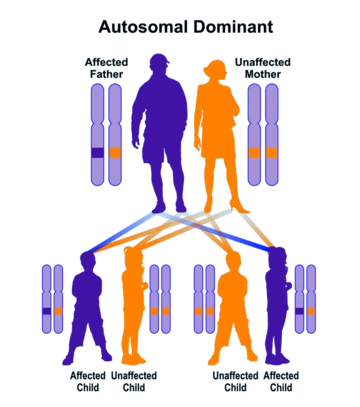
Autosomal dominant inheritance leads to a vertical pattern of transmission